May 16, 2026 • Dale Kosmicki • 9 min reading time • Prices verified May 24, 2026
Bench Grinder Specs That Actually Matter: Wheel Size, RPM, Arbor Bore, and Why Cheap Motors Eat CBN Wheels
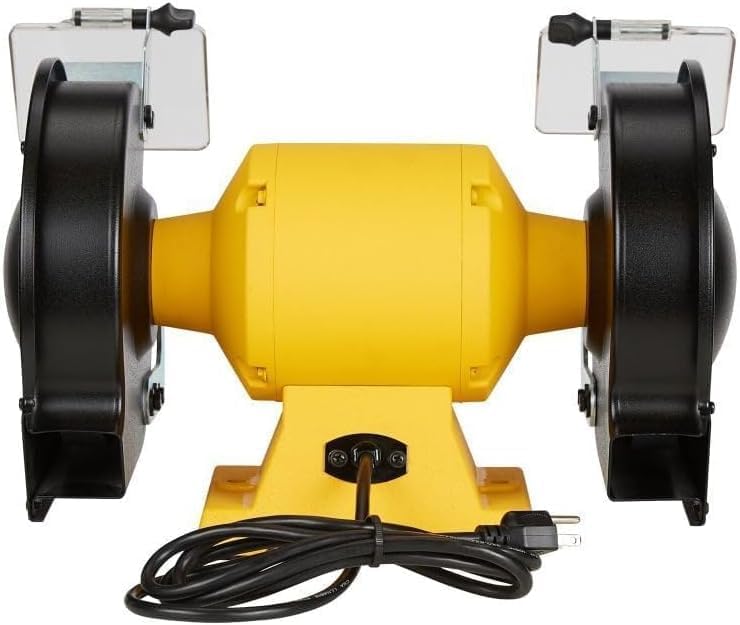
A bench grinder is exactly what it sounds like: a motor-driven machine that sits on a workbench and spins abrasive wheels (think of them as very hard, very aggressive sanding discs in rigid form) to sharpen tools, clean up welds, or shape metal. Most shops have at least one. A surprising number of shops have the wrong one — either underpowered for what they’re asking it to do, or spec’d without checking whether the spindle (the shaft the wheel mounts onto) matches the wheel they want to run. The result is either a machine that bogs down on tough jobs, a wheel that doesn’t fit, or — worst case — a safety event that lands on OSHA’s radar.
This guide is for the person who’s about to buy a bench grinder and wants to do it once correctly. We’ll walk through the specs that actually drive performance and safety: wheel diameter, motor amperage, surface speed (SFPM), arbor bore size, and the often-ignored question of whether a given motor can handle premium superabrasive wheels like CBN (cubic boron nitride — an extremely hard synthetic abrasive used for grinding hardened steel) without destroying them. By the end, you’ll have a clear decision framework, not a spec sheet you have to decode yourself.
| EDITOR'S PICKJET 8-Inch Bench Grinder | Mid-tierDEWALT DW758 8-Inch Bench Grind… | Budget pickJET 8-Inch Industrial Bench Gri… | |
|---|---|---|---|
| Motor HP | 1/2 HP | — | 1 HP |
| RPM | 3450 | — | 3600 |
| Voltage | 120V | — | 115V |
| Price | $399.00 | $136.76 | |
| See on Amazon → | See on Amazon → | See on Amazon → |
Wheel Size and RPM: These Two Numbers Live Together
When you see a bench grinder listed as “8-inch,” that’s the diameter of the abrasive wheel it’s designed to spin. Common sizes are 6-inch and 8-inch for general shop use, with 10-inch machines stepping into heavier industrial territory. Bigger wheels give you a larger flat grinding surface and — at the same RPM — a faster surface speed at the wheel’s edge.
That surface speed, measured in surface feet per minute (SFPM), is the number that actually governs how aggressively and safely the wheel cuts. The formula is straightforward:
SFPM = (Wheel diameter in inches × π × RPM) ÷ 12
A standard 3,450 RPM motor spinning a 6-inch wheel produces roughly 5,400 SFPM. The same motor on an 8-inch wheel? About 7,200 SFPM. Most vitrified (glass-bonded) aluminum oxide wheels are rated to a maximum of 5,500–6,500 SFPM. Run them faster, and you’re outside the wheel’s rated speed — which is not a gray area. OSHA 1910.215 requires that the machine’s maximum RPM never exceed the wheel’s rated RPM. Period.
By the numbers:
| Wheel diameter | Motor RPM | Approx. SFPM | Typical max wheel rating |
|---|---|---|---|
| 6 in | 3,450 | ~5,400 | 5,500–6,500 SFPM |
| 8 in | 3,450 | ~7,200 | 6,500–8,600 SFPM (check wheel label) |
| 8 in | 1,725 | ~3,600 | 4,500+ SFPM (slow-speed grinders) |
This is why “slow-speed” bench grinders (1,725 RPM) exist — they’re not underpowered for marketing reasons. Running 8-inch wheels at half the RPM keeps SFPM in a safe range for certain wheel grades and for heat-sensitive applications like sharpening high-speed steel (HSS) tooling where overheating ruins the tool’s temper.
The practical takeaway: before you buy, decide what wheel size you’ll run and what wheels you’ll source, then verify the grinder’s RPM keeps you inside that wheel’s rated SFPM. ANSI B7.1 (Safety Requirements for the Use, Care and Protection of Abrasive Wheels, published by the American National Standards Institute) is the governing document here, and any wheel manufactured for the U.S. market should have its maximum operating speed printed or stamped on it. If it doesn’t, don’t mount it.
Arbor Bore: The Spec Everyone Forgets Until It’s Too Late
The arbor bore is the hole in the center of the wheel — the opening that slides over the grinder’s spindle. It sounds too simple to matter, but it’s where a lot of sourcing headaches live.
Standard bench grinder spindles in the U.S. are most commonly 1/2-inch or 5/8-inch diameter. Most commodity 6-inch wheels ship with a 1/2-inch bore. Many 8-inch wheels — and almost all CBN and diamond wheels — are bored at 5/8-inch or larger. Superabrasive wheel manufacturers (Norton, Noritake, Camel Grinding Wheels) sometimes offer 1-inch bore on shop-grade CBN wheels. If your grinder spindle is 1/2-inch and your CBN wheel is bored to 1-inch, you can’t run a reducer bushing and call it solved — the centering tolerance matters. Eccentric mounting causes vibration, and vibration at 3,450 RPM turns into wheel damage, spindle bearing wear, and workpiece chatter in a hurry.
Before you commit to any bench grinder, pull the spec sheet for the wheel you intend to run long-term. If you’re planning to upgrade to CBN for grinding hardened steel or carbide tooling, confirm the grinder’s spindle diameter, then source the wheel to match — not the other way around.
Motor Quality: Where Cheap Grinders Reveal Themselves
Here’s the core argument of this article: the motor is the hidden purchase. The wheel size is visible. The arbor bore is measurable. But the motor’s quality — its rated amperage, duty cycle, and bearing grade — is what determines whether this machine is still running in five years or gets replaced twice.
Cheap bench grinders in the $60–$120 range typically use universal motors (the kind with brushes) or lightly built induction motors with ball bearings spec’d for intermittent use. For occasional deburring or tool touch-up — say, ten minutes a day — that’s fine. For a production toolroom running multiple shifts or sharpening HSS lathe bits by the dozen, you’ll burn through motor brushes, heat-soak the windings, and start seeing RPM droop under load. That RPM droop is the mechanism that destroys CBN wheels.
CBN (cubic boron nitride) wheels are precision-balanced, vitrified-bond superabrasive tools that cost anywhere from $80 to several hundred dollars per wheel depending on diameter and bond grade. They are designed to operate at a consistent, steady surface speed. When a motor bogs under load — dropping from 3,450 RPM to 2,800 RPM — the effective SFPM swings outside the wheel’s designed operating window. The wheel starts loading (metal chips clog the abrasive pores), and the heat spikes. On a CBN wheel, repeated heat cycling degrades the vitrified bond. You won’t see the damage until the wheel starts glazing over or you notice the surface finish deteriorating. At that point, the wheel is done.
For shops running CBN, the baseline requirement is a continuous-duty induction motor — not universal, not “equivalent to” continuous duty — with a minimum 1/2 HP (horsepower) rating for 6-inch applications and 3/4 to 1 HP for 8-inch production work. Baldor Electric (a brand well-regarded in industrial motor applications) builds bench grinder motors that hold RPM tightly under load; their designs are the reference point that separates a real shop machine from a home-center unit. As of mid-2026, Baldor-spec bench grinders and Baldor-motor-equipped units remain in the $250–$469 range for 8-inch configurations — not cheap, but significantly cheaper than replacing CBN wheels twice a year.
For toolroom managers equipping a crew for daily HSS and carbide grinding, this is the machine to anchor on:
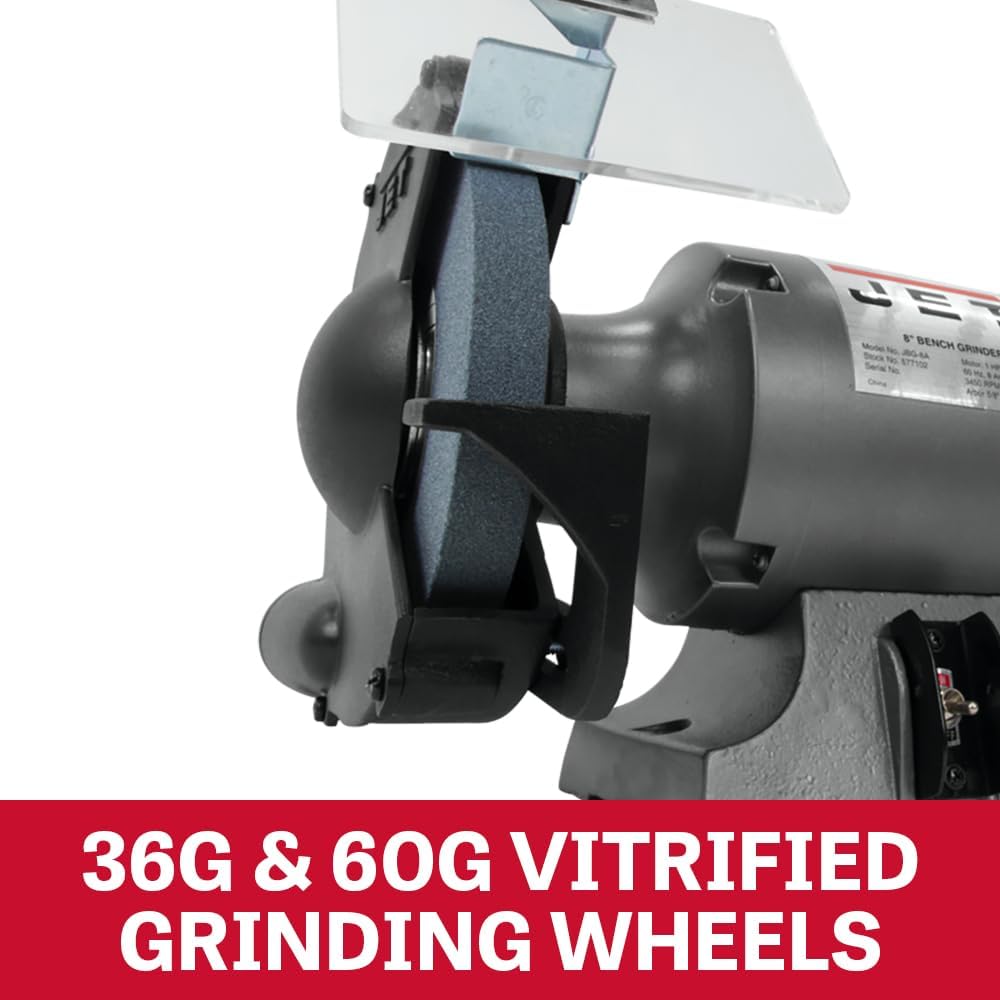
JET
$399.00
In stock on Amazon
Check price on AmazonFor a single-station shop doing occasional weld cleanup and tool touch-up with standard aluminum oxide wheels, a mid-tier induction-motor unit covers the bases without the premium cost:
DEWALT
$136.76
In stock on Amazon
Check price on AmazonAnd for a job shop adding a second station on a budget, knowing they’ll run gray aluminum oxide wheels and nothing more exotic:
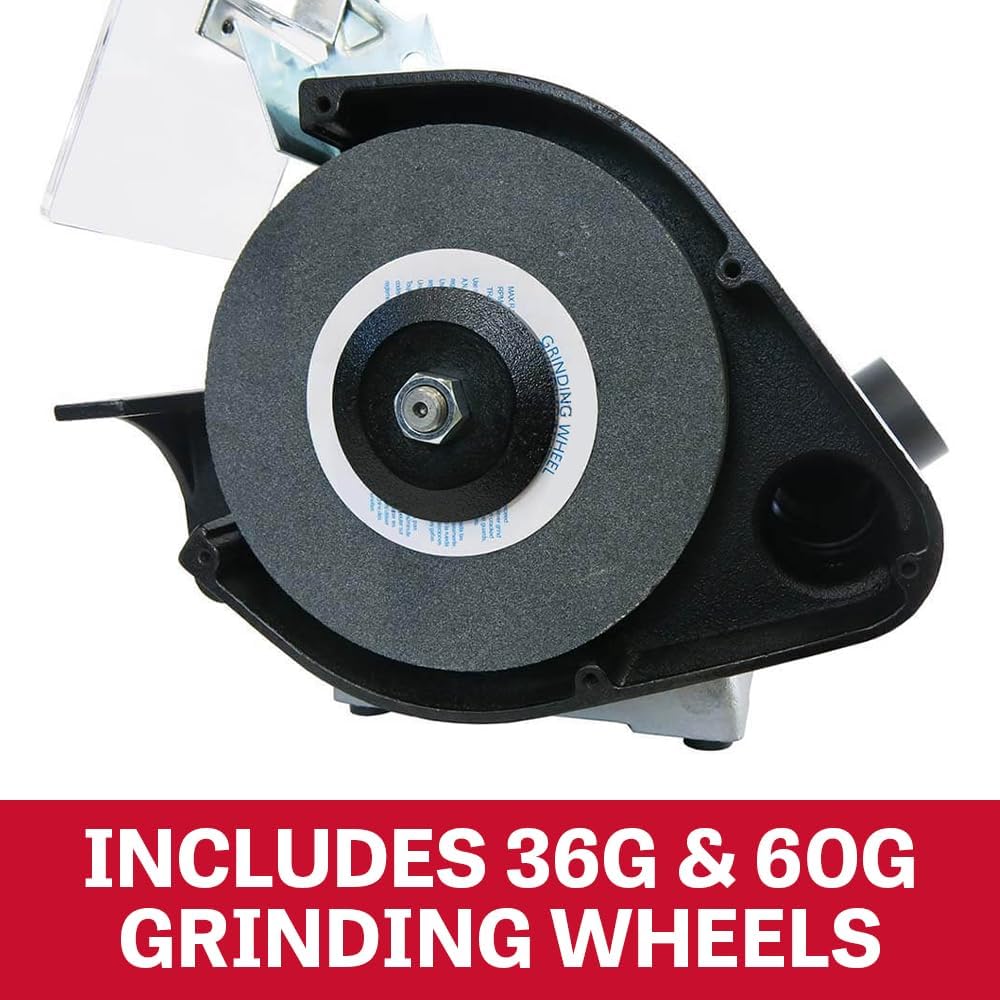
JET IBG-8
In stock on Amazon
Check price on AmazonMatching the Grinder to the Work: Decision Rules
The specs above feed into real decisions. Here’s how to close the loop:
If you’re sharpening HSS tooling and drill bits (not carbide, not CBN): A 6-inch, 1/2 HP slow-speed (1,725 RPM) grinder with standard aluminum oxide wheels is the right call. Slow-speed keeps the surface speed down, which means less heat transferred into the tool tip — critical for maintaining hardness in HSS. You don’t need CBN here, and you don’t need a heavy motor. A quality mid-tier unit lasts years.
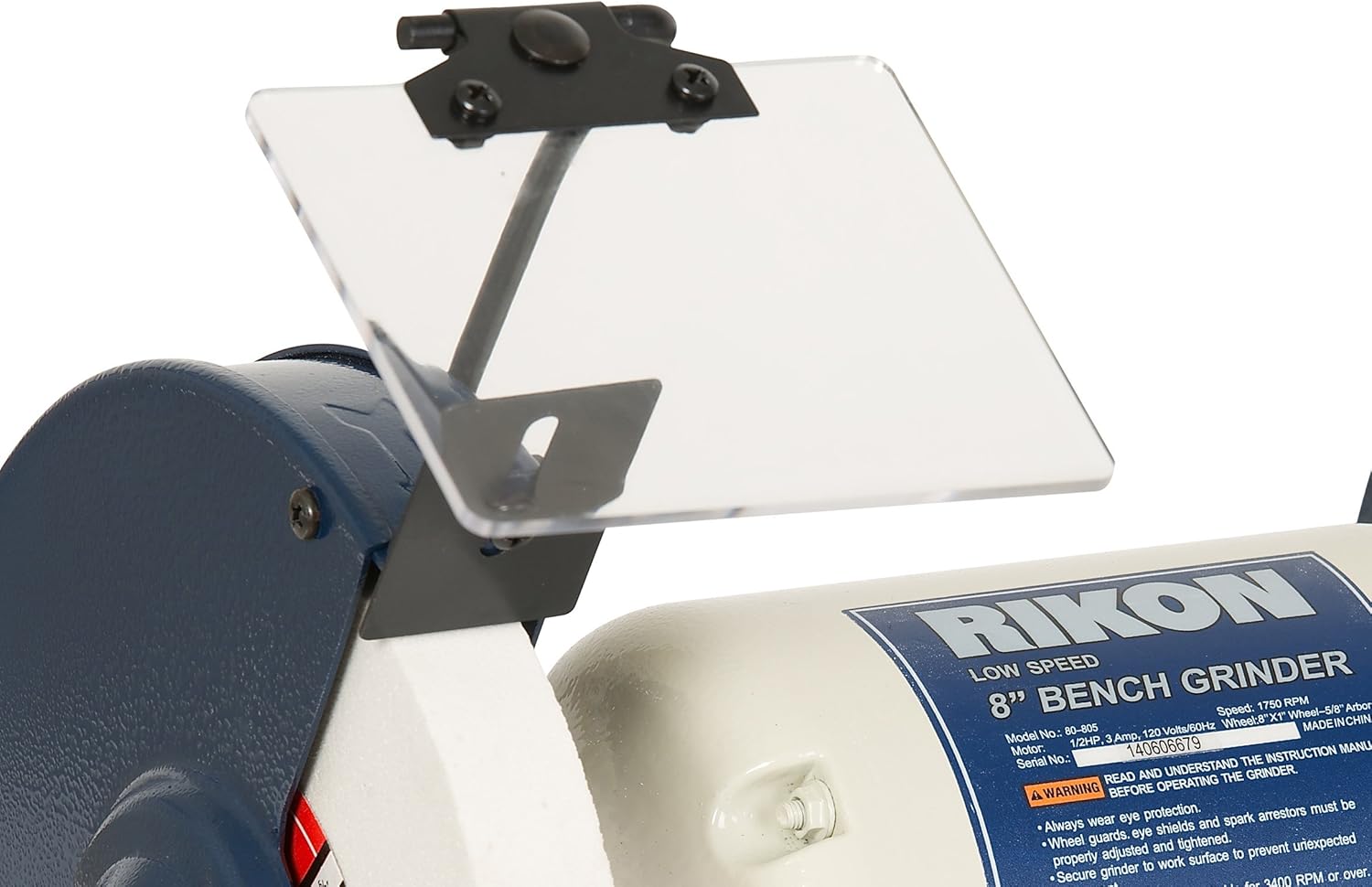
RIKON
$152.25
In stock on Amazon
Check price on AmazonIf you’re grinding hardened steel, carbide tooling, or HSS inserts at volume: This is the CBN use case. Get an 8-inch, 3/4–1 HP continuous-duty induction motor with a 5/8-inch or larger spindle. Verify the spindle bore before ordering wheels. Budget $250–$469 for the machine, plus $100–$300 for a quality CBN wheel. That’s a $400–$770 commitment, but CBN wheels last years when run correctly — the cost-per-grind math favors them heavily over aluminum oxide for hard materials, as Modern Machine Shop has documented in grinding consumable benchmarks.
JET IBG-8
In stock on Amazon
Check price on AmazonIf you’re running a multi-station toolroom: Standardize on one motor platform. Mixing wheel sizes and spindle bores creates a sourcing headache when you’re ordering wheels for six machines. Pick one 8-inch platform, buy CBN wheels with matching bores, and train everyone on the same machine. The Fabricator has noted that toolroom standardization is one of the lowest-effort TCO (total cost of ownership) improvements small job shops make.
JET
$399.00
In stock on Amazon
Check price on AmazonIf you genuinely just need weld spatter cleanup and light deburring, a few times a week: The $80–$120 tier is fine. Run standard 60-grit aluminum oxide wheels, replace them when they dress down below the safe diameter (typically 1 inch smaller than the wheel’s rated diameter — check the guard clearance), and don’t waste money on CBN. The machine will outlive its useful role before it wears out.
DEWALT
$136.76
In stock on Amazon
Check price on AmazonA Word on Guards, Flanges, and Compliance
No bench grinder article is complete without the safety box. OSHA 1910.215 mandates that bench grinders have:
- Wheel guards enclosing at least 270 degrees of the wheel, leaving the working face exposed
- Adjustable work rests no more than 1/8-inch from the wheel face
- Tongue guards (the small adjustable guard at the top of the exposed arc) set within 1/4-inch of the wheel
The flange size — the metal washers that clamp the wheel to the spindle — must match the wheel diameter per ANSI B7.1. Undersized flanges concentrate clamping force at the bore, which can crack vitrified wheels under load. This isn’t a compliance technicality; it’s the primary mechanical reason wheels shatter.
When you receive a new grinder, check all three guard settings before the first wheel is mounted. Cheap machines sometimes ship with work rests set loose from the factory. That 1/8-inch gap isn’t decoration — it prevents a workpiece from jamming between wheel and rest and kicking back at the operator.
The Short Version
Bench grinder specs aren’t complicated once you strip out the marketing. Wheel size and RPM are married — check both against your wheel’s rated SFPM before you buy. Arbor bore determines which wheels you can actually run, so spec the wheel first if CBN is in your future. Motor quality — specifically continuous-duty induction vs. brush-type universal — is the single biggest differentiator between a machine that runs CBN for five years and one that ruins a CBN wheel in six months. And OSHA 1910.215 and ANSI B7.1 compliance are the floor, not a bonus feature.
If you’re outfitting for production grinding of hardened or carbide tooling, spend the $350–$470. If you’re doing light weld cleanup a few times a week, the budget tier is genuinely fine. The mistake is mixing those two scenarios up — buying cheap for production work, or overpaying for light-duty use.
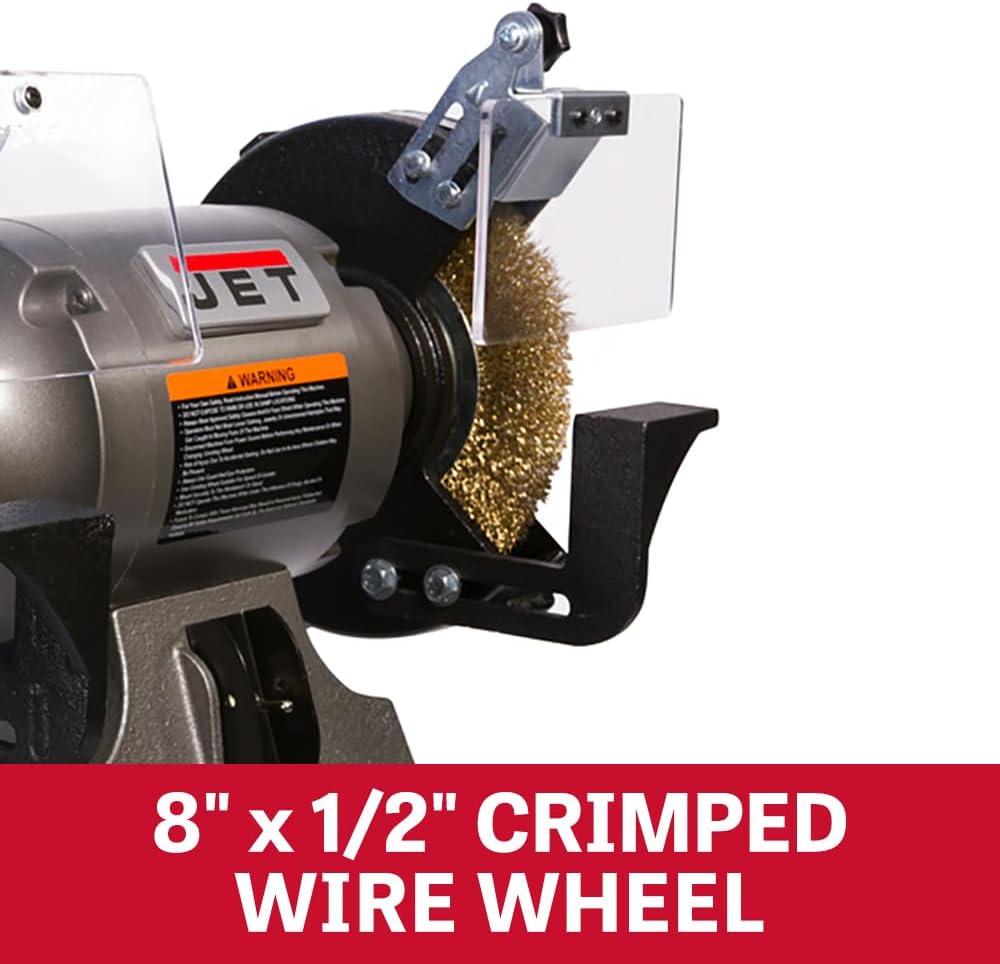
JET JBG-8W
$469.99
In stock on Amazon
Check price on AmazonGet the spec match right before checkout and you’ll make this purchase once.