May 16, 2026 • Dale Kosmicki • 10 min reading time • Prices verified May 24, 2026
Pneumatic Belt Sanders for Metal Finishing: CFM Math, SFPM Ratings, and the Ingersoll Rand Benchmark
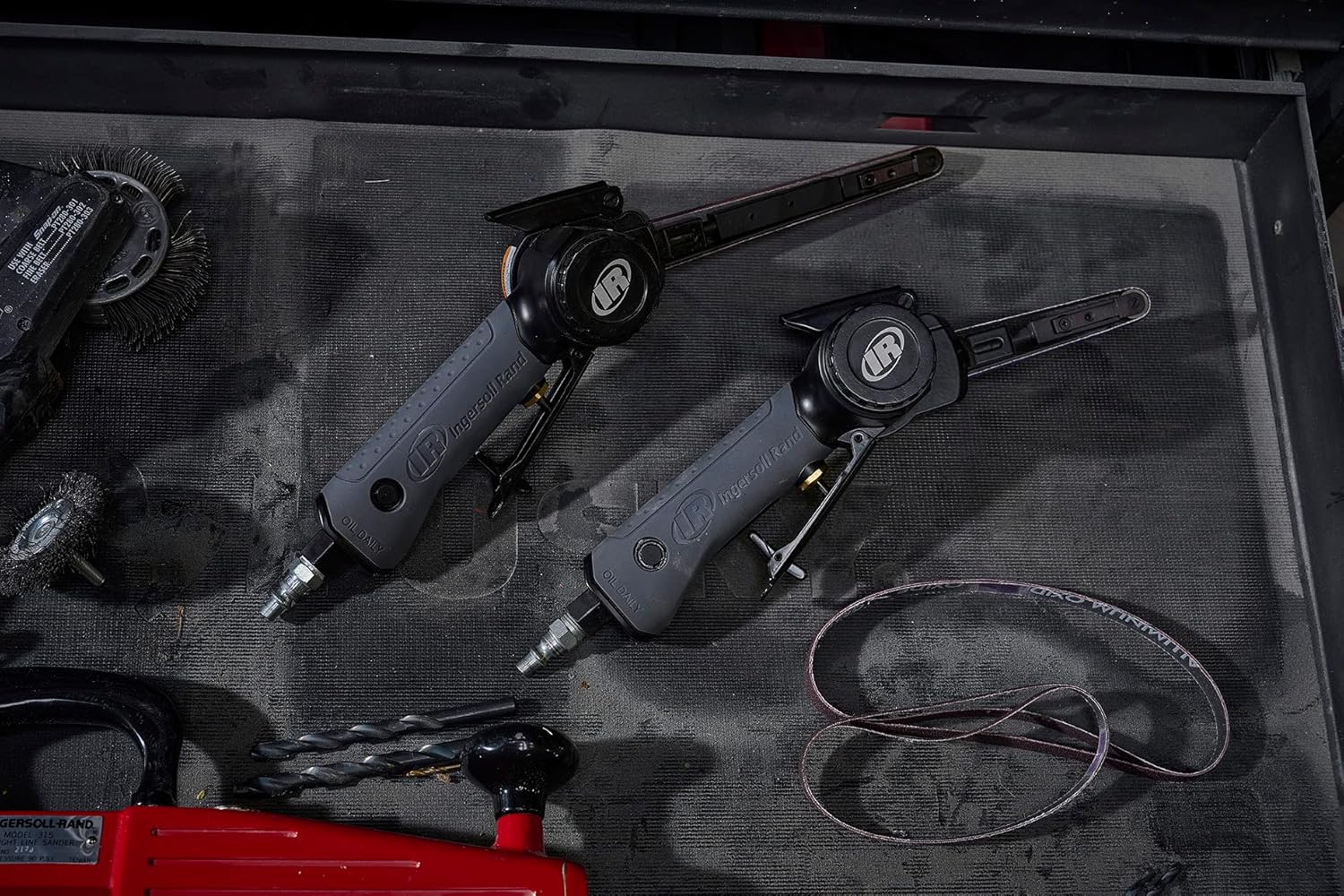
If you’ve ever watched a weld bead disappear under a smooth, machine-finished surface in under a minute, there’s a decent chance a pneumatic belt sander — an air-powered tool that drives a continuous loop of abrasive material across a workpiece — was doing the work. These tools run on compressed air instead of electricity, which matters in metalworking shops for a few reasons: no motor overheating on long passes, no electric sparks near metal chips and coolant, and easy speed adjustment by tweaking the air regulator. The downside is they need a compressor big enough to keep up, and that’s exactly where a lot of buyers get burned. This guide walks through the real numbers behind air supply requirements, belt speed ratings, and how Ingersoll Rand — one of the most widely benchmarked names in the category — stacks up. By the end, you’ll have a decision framework you can apply to your shop’s specific situation.
| EDITOR'S PICKIngersoll Rand 360-418 - Air Be… | Mid-tierEX ELECTRONIX EXPRESS Mini 1 x… | Budget pickWEN 6307 Variable Speed Detaili… | |
|---|---|---|---|
| Motor power | 0.6 HP | — | — |
| SFPM | 4700 SFPM | — | 1800 FPM |
| RPM | 20,000 RPM | 3400 RPM | — |
| Belt size | 1/2"x18" | 1"x30" | 1/2"x18" |
| Type | Pneumatic | Electric | Electric |
| Price | $114.99 | $69.99 | $28.10 |
| See on Amazon → | See on Amazon → | See on Amazon → |
Why CFM Is the Number That Will Break Your Budget
CFM stands for cubic feet per minute — the volume of air a tool consumes while running. Every pneumatic tool has a rated CFM draw, and your compressor has to deliver that volume continuously, not just in burst. This is the spec that most buyers skim past and most regret skipping.
Here’s the math that matters: a typical 1-inch × 18-inch inline pneumatic belt sander for light deburring might draw 4–5 CFM at 90 PSI. Scale up to a 2-inch × 42-inch file-belt tool for weld seam blending and you’re looking at 8–12 CFM. A two-operator shop running both at the same time needs a compressor with at least 20 CFM of sustained delivery — not the peak CFM rating printed on the tank badge, which reflects tank discharge, not sustained output.
By the numbers — common pneumatic belt sander CFM draws:
| Belt Size | Typical Use | CFM @ 90 PSI |
|---|---|---|
| 1” × 18” | Deburring, detail work | 4–5 CFM |
| 1” × 30” | Weld prep, general finishing | 6–8 CFM |
| 2” × 42” | Seam blending, heavy stock removal | 9–12 CFM |
| 3” × 21” (angle-head) | Surface conditioning, large panels | 10–14 CFM |
If your compressor is rated at 15 CFM but runs at 80% duty cycle, your effective continuous supply is 12 CFM. Put a 2-inch tool and a 1-inch tool on the same line and you’re starving both of them — slower belt speed, reduced cut rate, and accelerated belt wear. That last part hits your consumable cost, which is where most of the total-cost-of-ownership math hides.
The fix is either a larger compressor, a dedicated drop line sized for the tool (3/8-inch ID minimum for most belt sanders; 1/2-inch for the 10+ CFM tools), or honest scheduling so tools aren’t running simultaneously. All three are cheaper than burning through belts at twice the normal rate.
SFPM: The Number That Tells You How Fast the Belt Is Actually Moving
SFPM — surface feet per minute — is the linear speed of the abrasive belt as it contacts the workpiece. This is the spec that determines how aggressively the tool cuts, how long your belts last, and whether you’re creating heat that warps thin stock or discolors stainless.
Most pneumatic belt sanders for metalworking run between 1,500 and 3,000 SFPM depending on belt size and regulator setting. For context:
- Below 1,500 SFPM: mostly wood-finishing territory; too slow for efficient metal stock removal
- 1,500–2,200 SFPM: good range for stainless and aluminum where heat is a concern; 80-grit Zirconia works well here
- 2,200–3,000 SFPM: standard range for carbon steel deburring and weld seam blending
- Above 3,000 SFPM: some aggressive file-belt tools operate here for heavy stock removal; belt life shortens and heat management becomes critical
SFPM isn’t always listed prominently in tool specs — manufacturers often bury it or express it as no-load RPM, which you then have to convert using wheel or drive-roller diameter. The conversion is simple: SFPM = (RPM × π × diameter in inches) ÷ 12. If a vendor gives you RPM but not SFPM, do the math before you buy.
Why does this matter practically? ANSI B7.1 — the Safety Requirements for the Use, Care, and Protection of Abrasive Wheels, published by the American National Standards Institute — requires that abrasive products never be operated above their rated maximum speed. A belt rated for 3,000 SFPM run on a tool that delivers 3,800 SFPM under light load is a compliance failure and a safety one. The same standard that governs grinding wheels extends to coated abrasive belts used on power tools. Additionally, OSHA 1910.215 explicitly covers abrasive machinery in the general industry context, and the two standards are complementary in establishing safe operating limits. This isn’t box-checking; a belt failure at 3,500 SFPM on a metal workpiece sends fragments in a bad direction.
The Ingersoll Rand Benchmark — What It Earns and Where It Stops
Ingersoll Rand’s pneumatic line-up is the benchmark against which most mid-tier and premium buyers measure belt sanders, and for reasonable cause. Their tools are built to consistent QA tolerances, parts availability in North America is solid, and the brand’s industrial distribution network means you’re not waiting three weeks for a throttle valve. The 1-inch inline sanders in their catalog have been workhorses in job shops for decades.
What Ingersoll Rand earns specifically:
- Motor longevity: The vane motor designs used in their inline sanders handle dirty shop air better than cheaper aluminum-ported alternatives. If your air dryer is marginal, this matters.
- Throttle feel: The lever action on their grips gives operators good progressive control — you’re not toggling between full-speed and off, which extends belt life on finish passes.
- Parts ecosystem: Rebuild kits, rotor blades, and bearings for Ingersoll Rand pneumatic tools are stocked by major industrial distributors including MSC Industrial Direct (mscdirect.com). Availability for any specific model should be confirmed directly with the distributor before purchase, but the general parts support for established Ingersoll Rand pneumatic lines is a documented advantage over offshore alternatives with no MRO footprint. Downtime on a repair is hours, not weeks, when parts are on a distributor shelf.
Where the Ingersoll Rand benchmark ends: the 2-inch and larger format. Their catalog doesn’t go deep into the file-belt and wider-format tools that serious weld-seam work demands. For production fabrication environments running 2-inch × 42-inch or 3-inch × 21-inch belts continuously, brands like Dynabrade and Chicago Pneumatic have purpose-built tools with better ergonomics for sustained overhead or vertical passes.
For occasional weld cleanup on a budget, the entry-tier inline tools get the job done without paying for features a part-time user won’t utilize. WEN — $28.10
For a crew doing daily deburring and weld prep across mixed materials, step up to the mid tier — the tooling cost difference is recovered in belt life alone within a few months.
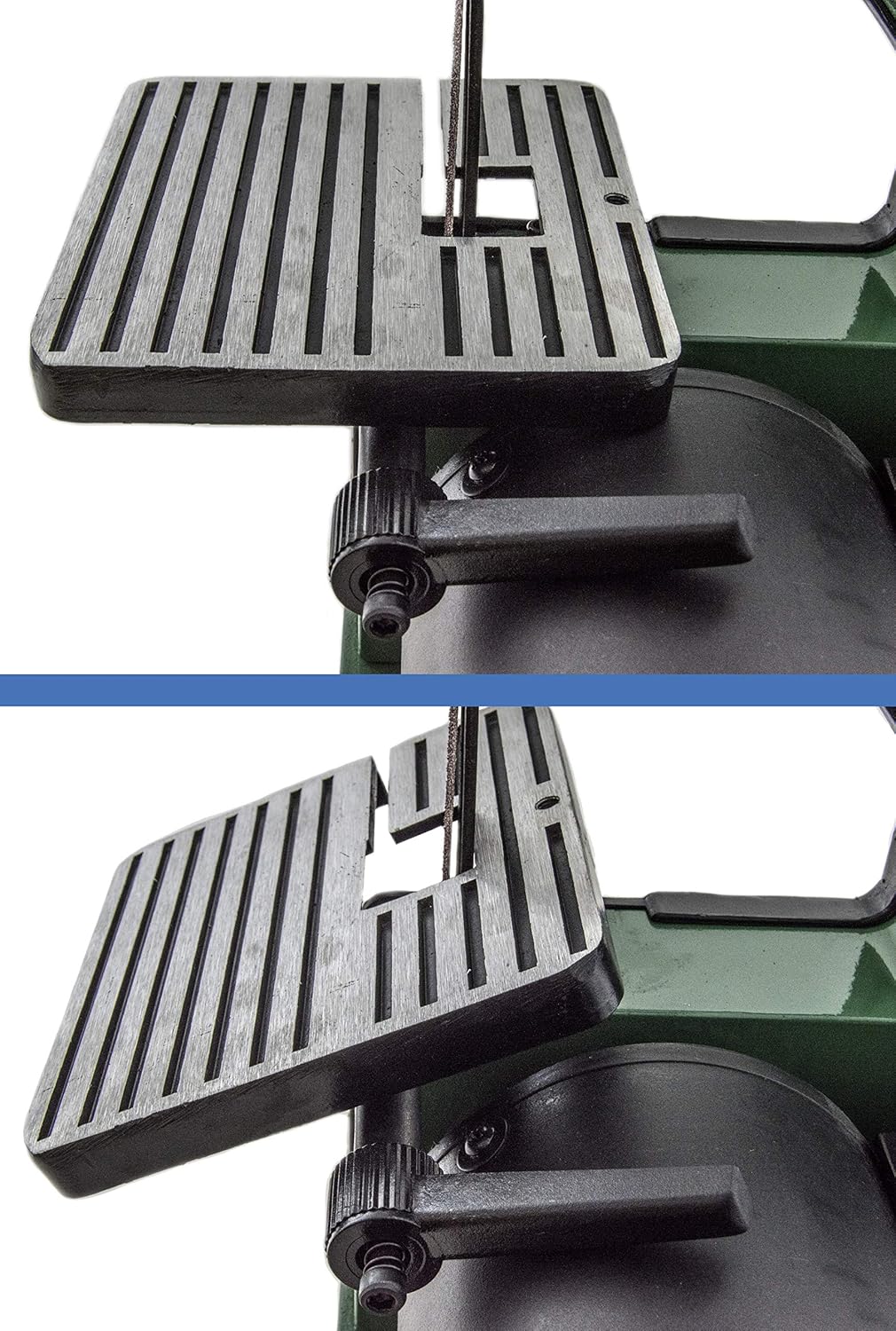
EX
$69.99
In stock on Amazon
Check price on AmazonFor production-rate fab shops where tool downtime costs more than the tool, the premium tier gives you the motor durability, ergonomics, and parts support that Ingersoll Rand represents at the top of the inline class — and where Dynabrade competes on the wider formats.
Ingersoll
$114.99
In stock on Amazon
Check price on AmazonChoosing by Use Case: A Decision Framework
The right tool depends on three inputs you already know: belt size needed, your compressor’s sustained CFM, and whether this is daily production or occasional finishing. Here’s how those inputs map to decisions.
If you’re doing light deburring and part cleanup, occasional use, on a shop compressor shared with other tools: A 1-inch × 18-inch inline tool at 4–5 CFM is the right size. Don’t overbuy. The budget tier handles this duty cycle without the premium price.
Ingersoll
$114.99
In stock on Amazon
Check price on AmazonIf you’re blending weld seams on carbon steel or mild alloy, daily, with a dedicated air line: A 1-inch × 30-inch or 2-inch × 42-inch tool at 6–10 CFM is the working range. This is where the Ingersoll Rand class earns its keep — look for SFPM ratings between 2,200 and 2,800 and a belt-tracking adjustment that doesn’t require tools to reset.
Ingersoll
$114.99
In stock on Amazon
Check price on AmazonIf you’re finishing stainless or aluminum where heat and contamination matter: SFPM control is critical. You want a tool with an in-line regulator that lets the operator back the speed down to 1,500–1,800 SFPM without starving the motor. Zirconia alumina belts in 60–120 grit are the consumable match here. The Fabricator covers practical abrasive selection guidance for stainless and aluminum finishing that’s worth bookmarking for your crew.
EX
$69.99
In stock on Amazon
Check price on AmazonIf you’re equipping a tool room or small job shop crew with multiple stations: Think about compressor headroom before you spec the tools. Total CFM demand across simultaneous use is the ceiling. A four-person crew each running a 6 CFM tool needs 24 CFM of sustained supply — plus buffer for air impacts and blow guns sharing the same main line. Size the compressor first, then pick tools that fit under that ceiling.
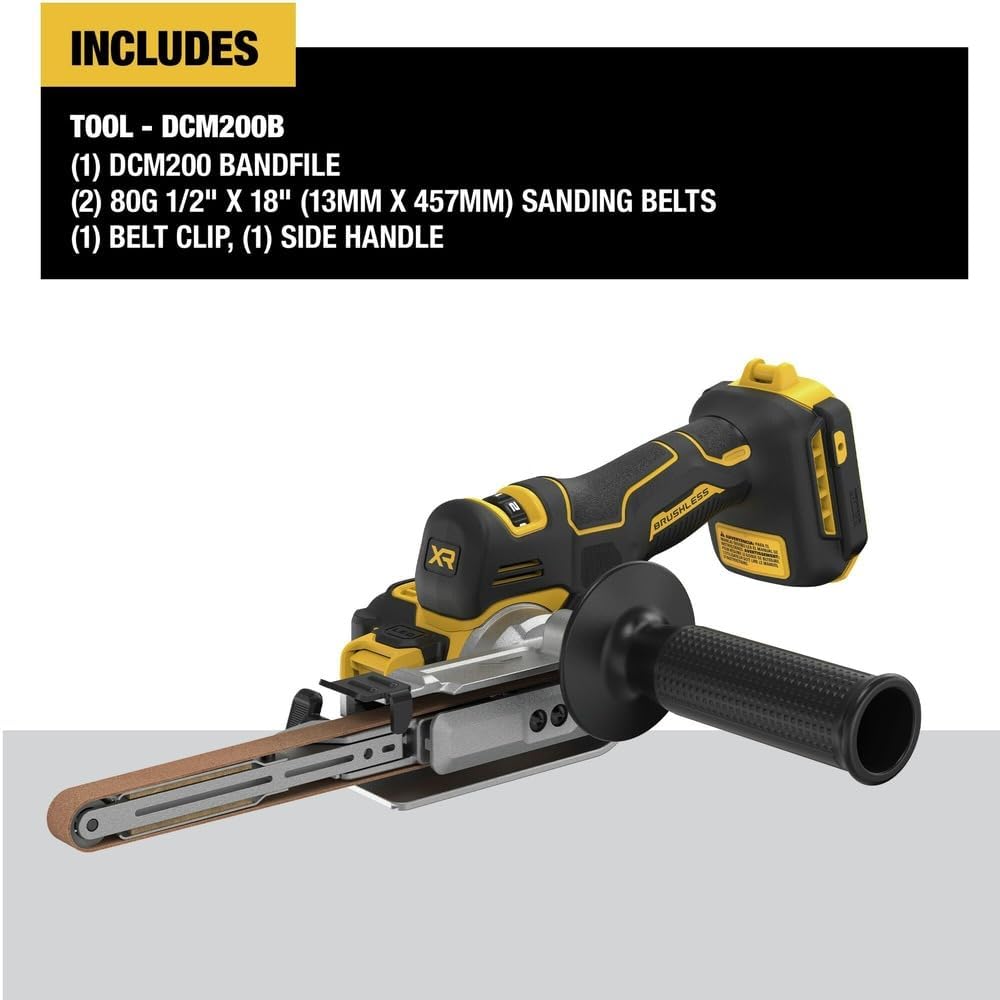
DEWALT DCM200B
$299.00
In stock on Amazon
Check price on AmazonTotal Cost Math: Where the Real Numbers Live
Purchase price on a pneumatic belt sander is almost irrelevant to total cost of ownership over a two-year horizon. The math is dominated by three variables:
- Belt consumption rate — a starved or overspeed tool burns belts 2–3× faster than a properly matched one. At $4–$12 per belt depending on size and abrasive type (Zirconia vs. ceramic vs. aluminum oxide), this adds up quickly across a shift.
- Compressor operating cost — electric demand on the compressor is a real line item. A 5 HP compressor running continuously to feed a 10 CFM tool costs more per hour than a 3 HP unit feeding a 5 CFM tool. Match tool to task, task to compressor.
- Downtime and repair — this is where cheap tools get expensive. A $89 offshore inline sander with no parts ecosystem costs a half-day of labor when the throttle valve fails. A tool from a brand with established MRO distribution — Ingersoll Rand and Dynabrade are two examples — where parts are stocked at industrial distributors such as MSC Industrial Direct (mscdirect.com), typically turns a repair in under an hour once parts arrive. Confirm current parts availability for your specific model directly with the distributor before committing to a platform.
For a tool-room manager equipping four stations with a two-year horizon, spending $40–$60 more per tool at purchase typically returns more than that in belt cost savings and reduced unplanned downtime in the first year alone. That’s the case for the mid-to-premium tier in daily use — not an upsell, just arithmetic.
The Bottom Line
Pneumatic belt sanders are one of the more underspecified tools in a metalworking shop — buyers focus on price, vendors lead with RPM, and the CFM and SFPM math gets skipped until the compressor starts short-cycling. Do the CFM math for your specific compressor and use pattern before you buy anything. Verify SFPM against your belt ratings to stay in compliance with ANSI B7.1 (American National Standards Institute, Safety Requirements for the Use, Care, and Protection of Abrasive Wheels) and OSHA 1910.215. And treat Ingersoll Rand as the baseline quality benchmark for inline 1-inch tools, while recognizing that the wider-format work needs a purpose-built tool from the Dynabrade or Chicago Pneumatic catalog.
Decision rule: If your use is occasional and your compressor is shared, budget tier is fine. If it’s daily and the tool is dedicated, the mid-to-premium tier pays for itself inside a year on consumables and uptime alone. If you’re outfitting a crew, size the compressor before you spec the tools — every time.
Ingersoll
$114.99
In stock on Amazon
Check price on Amazon